
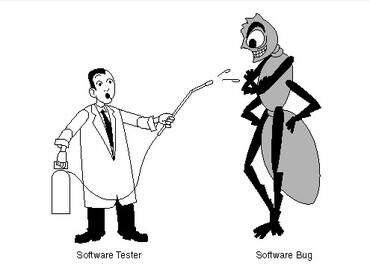
Clustering of abnormalities or bugs means that the distribution of defects is not even within an application. When the same tests are repeated over and over again, eventually the same test cases will no longer find new bugs. Clustering of bugs or abnormalities is not uniformly spread across the application, but typically bugs would typically be centralized in limited sections of the application. This is particularly true for large systems where mistakes made by developers could take a toll on the overall quality of the system. Indeed, over time, testers have observed a phenomenon where approximately 80% of the problems or malfunctions are caused by 20% of modules.
Clustering of abnormalities or bugs means that the distribution of defects is not even within an application. When the same tests are repeated over and over again, eventually the same test cases will no longer find new bugs. Clustering of bugs or abnormalities is not uniformly spread across the application, but typically bugs would typically be centralized in limited sections of the application. This is particularly true for large systems where mistakes made by developers could take a toll on the overall quality of the system. Indeed, over time, testers have observed a phenomenon where approximately 80% of the problems or malfunctions are caused by 20% of modules. Most of the testers have observed that this happens because an area of the code is complex and tricky.
Furthermore, information about clustering of abnormalities or bugs becomes particularly useful when making risk assessments for planning tests, and will focus on the known areas where bugs are aggregated. These areas are sometimes referred to as Hotspots. Such knowledge of the hotspots reduces the time and cost of identifying defects or anomalies within applications. After a certain number of test repetitions, the number of defects starts to reduce as the testing improves. The developers tend to be more careful in those places where testers have discovered bugs and focus less on other areas.
Consequently, executing the same test cases ceases to be as effective as it was originally in the beginning of the exercise. Following the same test cases would no longer be sufficient to discover more defects. Therefore the test cases need to be reviewed and adjusted in order to discover more bugs that could be in the software. It is a good idea at such stage to prepare new test cases and add them to the existing ones. In addition, testers can identify and remove test cases that are no longer effective.
https://www.utest.com/articles/pesticide-paradox-in-software-testing